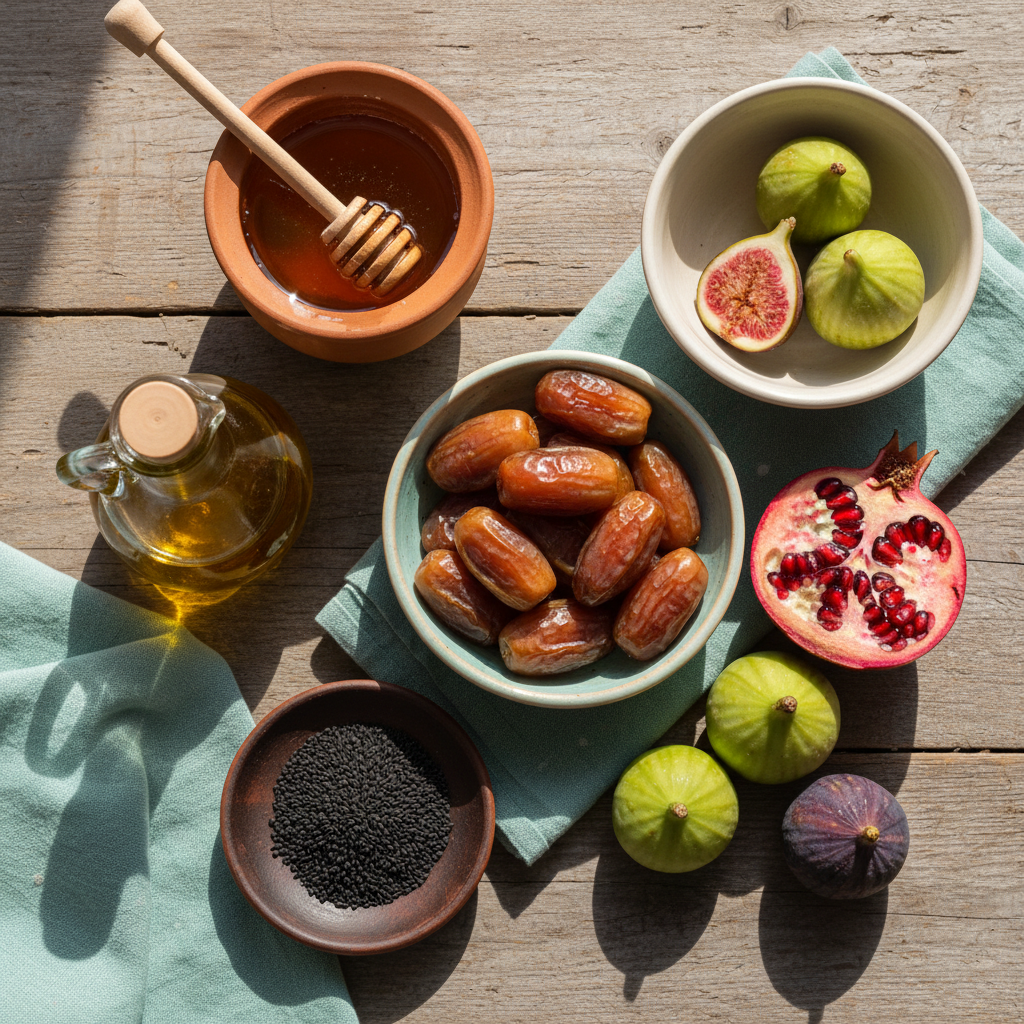
For 1,400 years, Muslims have consumed certain foods not just for sustenance but because the Prophet Muhammad ﷺ spoke about their benefits and regularly included them in his diet. These "Sunnah foods" occupy a special place in Muslim households — dates at iftar, olive oil drizzled over bread, black seed mixed with honey.
What is remarkable is how consistently modern nutritional science has validated these choices. Peer-reviewed research, clinical trials, and biochemical analyses have confirmed benefits that the Prophet ﷺ described fourteen centuries ago. This is not a coincidence to Muslims — it is confirmation.
Let us examine the evidence for five key Sunnah foods.
1. Black Seed (Nigella sativa) — Habbatus Sauda
The Prophetic Statement:
The Prophet ﷺ said: "In the black seed is a cure for every disease except death." (Sahih al-Bukhari, 5688)
What Modern Science Says:
Nigella sativa, commonly known as black seed or black cumin, has been one of the most extensively studied medicinal plants of the past three decades. The key bioactive compound is thymoquinone, which has demonstrated:
- Anti-inflammatory effects: A 2017 systematic review in Phytotherapy Research (PMID: 28371137) analyzed 13 clinical trials and found that Nigella sativa supplementation significantly reduced markers of systemic inflammation, including C-reactive protein (CRP).
- Blood sugar regulation: A meta-analysis published in the Journal of Ethnopharmacology (2017, PMID: 28249817) found that Nigella sativa supplementation reduced fasting blood glucose by an average of 45 mg/dL and HbA1c by 0.71% in patients with type 2 diabetes.
- Weight management: A 2018 systematic review in Complementary Therapies in Medicine (PMID: 30477842) found that Nigella sativa supplementation was associated with modest but significant reductions in body weight and waist circumference.
- Cardiovascular protection: Multiple studies have shown reductions in total cholesterol, LDL cholesterol, and triglycerides with regular black seed supplementation.
How to Use It: Add 1-2 teaspoons of ground black seed to smoothies, yogurt, or salad dressings. Black seed oil (cold-pressed) can be taken as a supplement, typically 1 teaspoon daily. Consult your provider if you are on blood-thinning medications.
2. Olive Oil (Zayt) — The Blessed Oil
Quranic and Prophetic References:
The olive is mentioned multiple times in the Quran. In Surah At-Tin (95:1), Allah swears by it: "By the fig and the olive." In Surah An-Nur (24:35), olive oil is described as fuel for the metaphorical lamp of divine light — "from a blessed olive tree." The Prophet ﷺ said: "Eat olive oil and use it on your bodies, for it is from a blessed tree." (Sunan at-Tirmidhi, 1851)
What Modern Science Says:
The Mediterranean diet, in which olive oil is the primary fat source, has been studied more extensively than almost any other dietary pattern. Key findings include:
- Cardiovascular protection: The landmark PREDIMED trial, published in the New England Journal of Medicine (2018, PMID: 29897866), followed 7,447 participants and found that a Mediterranean diet supplemented with extra-virgin olive oil reduced the incidence of major cardiovascular events by 31% compared to a control diet.
- Anti-inflammatory properties: Extra-virgin olive oil contains oleocanthal, a polyphenol that has been shown to have anti-inflammatory effects comparable to low-dose ibuprofen (Beauchamp et al., Nature, 2005, PMID: 16136122).
- Cancer risk reduction: A 2020 meta-analysis in Clinical Nutrition (PMID: 31757576) found that higher olive oil consumption was associated with a 31% lower risk of any cancer and a 28% lower risk of breast cancer.
- Brain health: Oleic acid and polyphenols in olive oil have been associated with reduced risk of cognitive decline and Alzheimer's disease in longitudinal studies published in Neurology (2022).
How to Use It: Use extra-virgin olive oil (EVOO) for dressings, dipping, and low-to-medium heat cooking. Aim for 2-3 tablespoons daily. Look for dark bottles with harvest dates to ensure freshness, as polyphenol content decreases over time.
3. Dates (Tamr) — The Fruit of Paradise
Prophetic Practice:
The Prophet ﷺ broke his fast with dates and water. He said: "When one of you breaks his fast, let him break it with dates, for they are a blessing. If he does not find dates, then let him break it with water, for it is purifying." (Sunan at-Tirmidhi, 658)
What Modern Science Says:
- Nutrient density: Dates are rich in potassium (696 mg per 100g), magnesium (54 mg per 100g), vitamin B6, iron, and dietary fiber (6.7g per 100g). They provide sustained energy through a combination of glucose, fructose, and sucrose alongside fiber that slows absorption.
- Glycemic impact: Despite their sweetness, dates have a moderate glycemic index (GI 42-55 depending on variety). A 2011 study in Nutrition Journal (PMID: 21631956) found that dates did not significantly spike blood glucose in healthy individuals or those with type 2 diabetes when consumed in moderate amounts (3-5 dates).
- Antioxidant properties: Research in the Journal of Agricultural and Food Chemistry (2005, PMID: 15769103) identified high concentrations of phenolic compounds and carotenoids in dates, with antioxidant activity comparable to citrus fruits.
- Labor and delivery: A 2017 Cochrane-style review in BMC Pregnancy and Childbirth (PMID: 28209120) found that date consumption in late pregnancy was associated with shorter labor duration and reduced need for labor induction.
During Weight Loss: Dates are calorie-dense (approximately 23 calories per date). Limit to 2-3 dates per serving. They are ideal for breaking fast, pre-workout energy, or satisfying a sweet craving without processed sugar.
4. Honey ('Asal) — Healing from the Hive
Quranic Reference:
Allah describes honey in Surah An-Nahl (16:68-69): "And your Lord inspired to the bee: 'Make your homes in the mountains, in the trees, and in the structures they raise. Then eat from every fruit and follow the paths of your Lord, made easy for you.' There comes forth from their bellies a drink of varying color, in which is healing for people. Indeed, in that is a sign for a people who reflect."
What Modern Science Says:
- Antimicrobial properties: Medical-grade honey, particularly Manuka honey, has been extensively studied for wound healing. A 2015 systematic review in PLOS ONE (PMID: 25734485) confirmed its efficacy against antibiotic-resistant bacteria including MRSA.
- Cough suppression: A 2020 systematic review in BMJ Evidence-Based Medicine (PMID: 32817011) analyzing 14 studies found honey was superior to usual care and antihistamines for upper respiratory cough symptoms.
- Prebiotic effects: Oligosaccharides in honey promote the growth of beneficial gut bacteria, particularly Lactobacillus and Bifidobacterium species, as shown in studies published in International Journal of Food Sciences and Nutrition (2012).
- Antioxidant activity: Raw honey contains flavonoids and phenolic acids with significant antioxidant capacity. Darker honeys (such as buckwheat) have higher antioxidant content.
During Weight Loss: Honey is calorie-dense (64 calories per tablespoon) and primarily composed of simple sugars. Use sparingly — 1-2 teaspoons per day in tea, yogurt, or dressings. Choose raw, unprocessed honey for maximum bioactive content.
5. Pomegranate (Rumman) — The Jeweled Fruit
Islamic Significance:
Pomegranates are mentioned in the Quran three times (Surah Al-An'am 6:99, 6:141; Surah Ar-Rahman 55:68) as among the fruits of Paradise. The Prophet ﷺ is reported to have said: "There is not a pomegranate which does not have a seed from the pomegranates of Paradise." (Narrated by Abu Nu'aym)
What Modern Science Says:
- Cardiovascular health: A 2017 meta-analysis in Pharmacological Research (PMID: 27888156) found that pomegranate juice consumption significantly reduced systolic and diastolic blood pressure. A separate study in Clinical Nutrition (2004, PMID: 15158307) showed that daily pomegranate juice consumption for one year reduced carotid artery plaque thickness by 30%.
- Antioxidant power: Pomegranate juice contains punicalagins and anthocyanins. Research published in the Journal of Agricultural and Food Chemistry (2000, PMID: 10691606) found its antioxidant capacity was three times higher than red wine or green tea.
- Anti-inflammatory effects: Ellagic acid and punicalagin in pomegranate have been shown to inhibit NF-kB, a key inflammatory pathway, in studies published in Journal of Nutritional Biochemistry (2005).
- Prostate and breast cancer research: Preliminary studies in Clinical Cancer Research (2006, PMID: 16818701) showed that pomegranate juice slowed PSA doubling time in men with prostate cancer, suggesting potential anti-cancer properties.
How to Use It: Eat pomegranate seeds (arils) as a snack or salad topping. Drink pure pomegranate juice (unsweetened) in moderation — 4 ounces daily. The seeds provide fiber that juice does not.
A Pattern of Wisdom
What emerges from this review is a consistent pattern: the foods the Prophet ﷺ recommended are nutrient-dense, anti-inflammatory, and protective against chronic disease. They are not exotic or expensive — they are accessible staples that have nourished communities for millennia.
Modern science does not validate Islam. Islam does not need validation. But for Muslims seeking to improve their health, it is deeply reassuring to know that the prophetic dietary tradition aligns so precisely with the best of contemporary nutritional research.
Incorporate these blessed foods into your daily meals — not as a magic solution, but as part of a balanced, intentional approach to nourishment. Your body and your deen will benefit. Bismillah.